
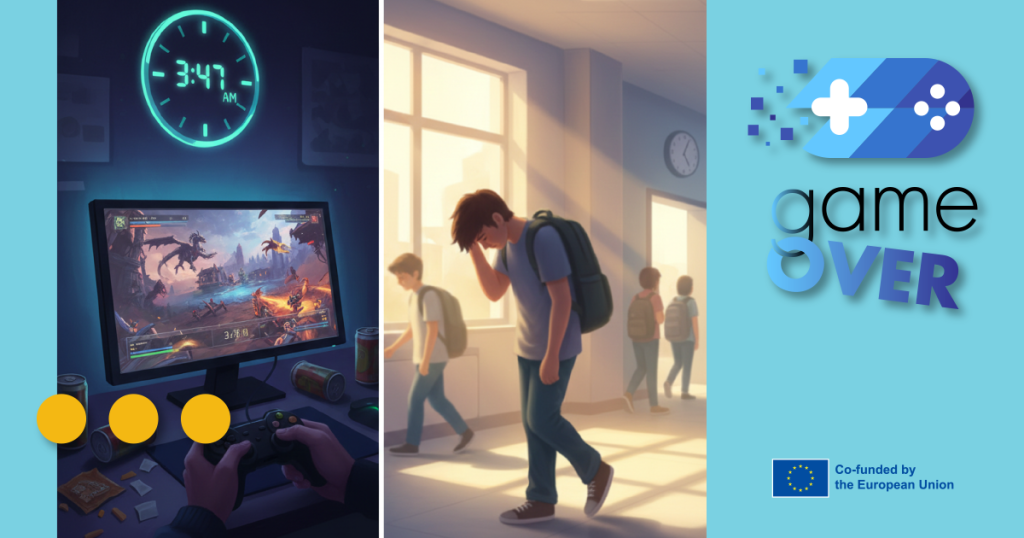
Developed under the Game Over Project
As online gaming becomes central to young people’s lives, some students develop Problematic Online Gaming (POG)—a pattern marked by loss of control and continued play despite negative consequences for sleep, academic performance, and wellbeing.
To respond to this growing concern, the Game Over Project developed a comprehensive set of tools:
- Early Detection Instrument (EDI) – ready for use
- Practical intervention toolkits – available soon
- An online training programme for professionals – coming soon
Together, these tools form a structured, research-informed system for prevention, early detection, and early intervention—supporting healthy digital engagement while protecting students’ wellbeing and academic success.
Research Foundation
The tools were developed through international research conducted in Bulgaria, Greece, Lithuania, and Spain.
Student Interviews
More than 40 students aged 11–17 participated in semi-structured interviews. Cross-country analysis revealed common patterns:
- Gaming replacing sleep and study time
- Emotional dependence on gaming
- Increasing family conflict
- Gradual academic disengagement
Development of the Psychometric Instrument
To measure problematic online gaming, researchers constructed a psychometric instrument aligned with the Diagnostic and Statistical Manual of Mental Disorders (DSM-5) and the **World Health Organization ICD-11 criteria for Gaming Disorder.
The instrument includes 18 items across 9 diagnostic categories: preoccupation, withdrawal, tolerance, failed attempts to control gaming, loss of interest in other activities, continued gaming despite harm, deception about time spent, gaming to escape negative mood, jeopardising social or educational opportunities.
Teacher Survey
A survey involving 95 teachers examined professional observations of POG in schools.
Teachers reported that problematic online gaming:
- Contributes to academic decline
- Affects emotional wellbeing
- Leads to social withdrawal
- Is becoming an increasingly serious concern
Key Findings
The research showed that:
- Gender, age, academic performance, and family income are more strongly associated with POG than personality traits.
- Personality characteristics show weak but statistically significant correlations, meaning they contribute to risk in combination with environmental and social factors.
POG is therefore multidimensional and influenced by individual, family, and contextual elements.
 Access the EDI here: https://gameover-project.eu/edi/
